My Best Two Words That Describe All Human Relationships
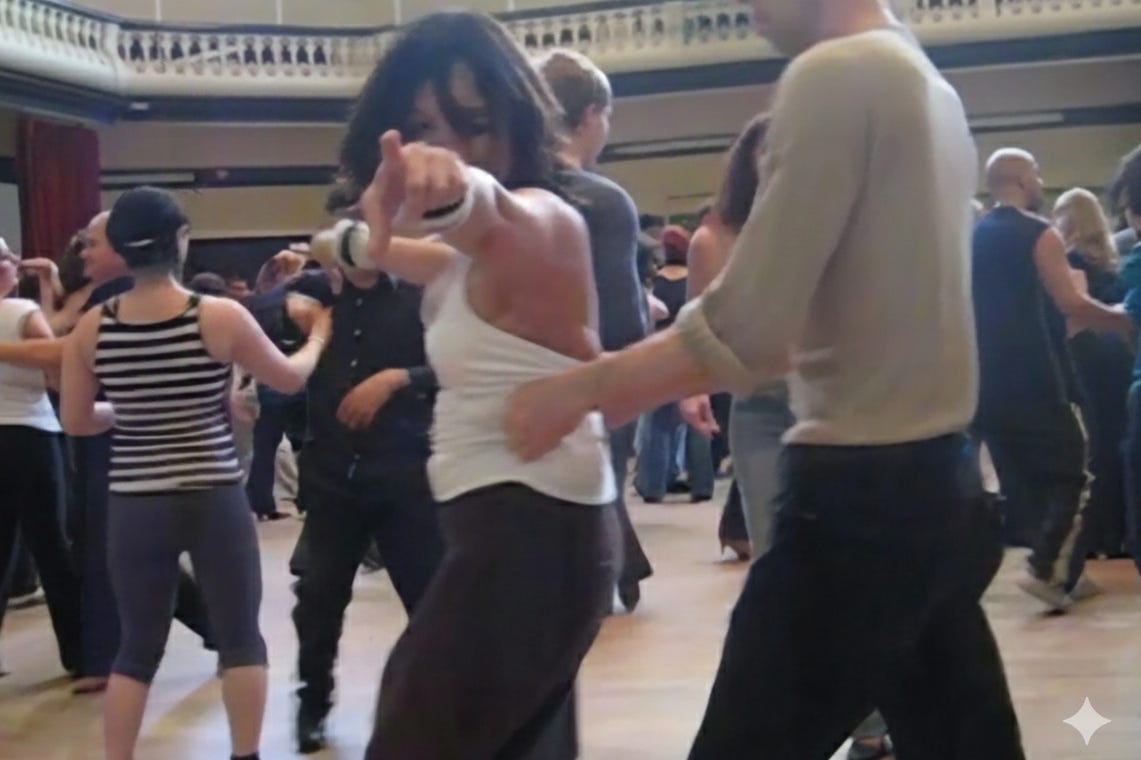
I found them on the floor at the Salsa club.

In my previous article, I talked about how learning to see the energy of trees was a life-changing experience. It turned out my artist’s vision of tree energy was based on solid scientific concepts. But, as clear as my vision was, the words to describe it in human terms eluded me. At least, until I started Salsa dancing.
But here’s a heads up. If you’ve seen my web site name, these words won’t be much of a surprise. It took me 10 years to get that domain name and another ten years to figure out a plan to write about the concept. So here’s my origin story of how I found these two words that describe all human relationships.
Around 1999 I discovered Latin dancing - and instantly fell in love with it. If you have ever been to a Salsa club you know what I mean when I say there is a lot of energy involved.
It’s not just volume. It’s qualitative. Everyone is different.
I learned to see that the people I met in the clubs, and especially the women I danced with, had unique energies. Remembering names and faces was a bit of a challenge for me. But remembering energy was a skill that emerged over time. When visiting new clubs I have often asked a ‘stranger’ to dance and then, once we start, I would remember that somewhere, some place, we have danced before. I just didn’t remember her appearance or her name.
Remembering a smile is much easier. The energy of it is kept in the heart which grows to accommodate it.
Learning to read energy became an important way to understand people - what kind of people they are, who to dance with, who to avoid or, at least, how to adjust to their reality.
I remember seeing a beautiful young woman at the club one night. She breezed past me on her way to join her friends at the table behind me. She was not a dancer - her head tilted forward as she walked. An experienced dancer acquires a level of confidence that will hold the head upright.
Another woman who was a regular seemed perpetually unhappy. Given the high intensity excitement of the club, this puzzled me. At first I wondered why she even bothered coming out to dance. But over time, it occurred to me that if she didn’t come out, life would have been that much worse for her. It’s sad to say, it became apparent that she carried a deep trauma from somewhere in her past.
Likewise, a man who came regularly was a dark soul who chose to lurk in the shadows at the back of the club. He was not unpleasant but his secret war with himself made it difficult to befriend him. He was not a Salsa dancer. His preference seemed to be a form of Merengue. When the Merengue set began he would emerge into the light, steal an unsuspecting woman from her seat and lead her to the back of the dance floor. If she ever smiled, a flash of joy would light up his face and then disappear, as he returned to his private fear.
Some men dance from the head. You can tell because they focus on complex arm movements, creating twists and turns, tying and untying the woman’s limbs. These men barely move below the neck, as if their bodies don’t exist.
Some dancers draw directly from a higher source - the music. They are the music made visible. (More about that in a minute.)
Everyone has a unique energy signature. And it reveals much about who they are and where they are in life. Dancing presents an opportunity to grow beyond old limitations. Some succeed, some don’t.
I was determined to succeed. I don’t know why. I simply had to.
Learning to dance was challenging enough but learning to lead was for me, and probably most men, absolute torture. Because we have to make so many instant decisions! My first dance instructor called me out on this immediately:
“Micha! You have flabby decision-making muscles!”
But it was hard! I had just spent the previous 20 years sitting at my desk, glued to a keyboard, telling a computer to do logical things. And here was this young woman telling me to turn my brain off and use my body to move hers in peculiar ways. All in time to fast music!
I cringed whenever she yelled “Right turn! Left Turn!” I would have been more relaxed on a roller coaster.
Despite my inexplicable desire to succeed at all this, my beginner self took a big ego hit. It was failure after failure. But look at the stuff men have to do in this partner dance thing! Not only do we have to learn how to move our feet in the right way at the right time, and memorize complicated sequences of steps, we also have to make up a choreography on the spot - all to keep our partner happy.
What manner of hell had I gotten myself into?
It took me a year of group lessons, private lessons, practicing in my oversized kitchen and testing stuff out at the clubs to prepare for my first Salsa Congress, where I knew I would be up against the best experienced dancers.
The plan worked enough that had a great time.
(But just between you and I, a video of me dancing with a famous instructor from LA showed my arms dropping to my sides like dead cats - a classic newbie flaw! The evidence was presented over and over at our club back home - someone decided it would be fun to play the congress video on the big screen every night. With that scrutiny, I learned to put energy into my arms at all times.)
It was at the Salsa Congress in 2000 that I first saw Albert Torres, the late renowned Puerto Rican-American Salsa genius and promoter. He danced like a Zen Master with a playful attitude I had never seen before.
I remember watching him dancing with a woman at one of the social dance events in the convention centre. The dance floor was the size of an airplane hangar. At the far side, near the main entrance, were several pairs of superstar dancers with crowds circled around them.
Albert was in a corner of the floor, just a few feet away from where I was sitting. A man, seemingly oblivious to everything around him, walked onto the dance floor and stood right in Albert’s space. But rather than getting upset with him, Albert simply incorporated him into the dance, pretending to be tired and on the 8-beat, resting his arm and head on the guy’s shoulder. It worked - both as a dance move and as a way to gently let him know he was in the way. I learned a lot from that.
Albert’s production company slogan was “Creating Unity Through Salsa”.

What did he mean by this? Perhaps it was an example of his anti-war stance I saw him take in the post-911 era. His email announcements would end with another powerful statement: “If everyone danced, there would be no war.” Again, he seemed to be going his own way, away from the crowd.
Over time, I formed some of my own ideas about that ‘Unity’. And now I see these words as the doorway to a very profound truth. But not only that - they also helped me find words to describe the qualities of energy that we can see in the dance. And trees.
Let’s look into this. Starting with a dance lesson.
Instructors will tell beginners:
“The man is the frame. The woman is the picture.”
Yes, the statement is completely sexist but, hang on, we’ll fix that in a moment. For now let’s just go with it because, for the most part, this is what you will find on the dance floor - men leading women.
This is what I learned through my years of dancing as a lead: my job is to provide my partner with not only moves that she knows, but also variations that make it interesting and fun for her to follow.
I have to provide a mixture of predictable moves and surprises.
That also happens to be the scientific ‘recipe’ for music - somewhere between Order and Chaos. It follows a pattern but presents new things that keep us interested.
In my previous article I spoke about a scientist, Richard F. Voss, who identified a way to understand music as a certain distribution of energy across a spectrum of frequencies. This is called the ‘1/f power spectrum’ (that’s ‘one over f’). To humans, these specific patterns of energy ‘feel right’. But ‘1/f power spectrum’ is a term I don’t want to use in polite, human company. Please bear with me, I’m going to fix that too.
The same ‘1/f’ pattern can be found throughout nature. My article focused on the way that pattern is present in the shape of trees, which of course ‘feel right’ to our eye.
Voss pointed out that 1/f is halfway between the hiss from a disconnected TV and a child practicing piano scales. 1/f is at the midpoint between chaos and order. Technically, the meaning can be simplified to:
the lower frequencies contain more power than the higher frequencies.
This is the pattern of energy I found in trees. And it turns out to be present throughout nature, and as I later learned, in human relationships.
I’ll be honest, the term ‘1/f power spectra’ doesn’t really land for most people when talking about how we get along in a dance club or with a life partner. For years I wished I had a better way to describe it.
Becoming a Salsa addict fixed that problem for me. Two words arrived that I think are much more suitable for human consumption:
Core-Radiance
Here’s where they come from:
“The man is the frame. The woman is the picture.”
In a partner dance, the ‘lead’ boils down to this: is a series of low-frequency decisions.
The ‘follow’ is high frequency styling.
The lead shapes the stylistic expression of the follow, giving it a deeper structure.
Roughly speaking, a guy makes a ‘lead decision’ about every 5 to 10 seconds or so (although it can feel a lot less than that). Within those 5 to 10 seconds the follower has time and space for improvisation. The hand styling, hip gyrations, hair flicks, and (hopefully) smiles all contribute to the expressiveness of the dance.
The lead is low frequency power that guides the follower and shapes the choreography. This is Core energy.
The follower makes higher frequency, lower power decisions within the envelope of the lead moves. This is Radiant energy.
Sound simple?
It’s not really that simple.
It doesn’t take much to see that an experienced lead also improvises with styling and does so at a pretty high frequency all through the dance. In fact, if he is very experienced at the dance, he directly channels the feeling of the music into expressive interpretations. He is also Radiant.
And the follower can also define space in powerful ways. It is common to see an experienced female dancer move smooth, strong, graceful - like a leopard. She is confident at her Core. And her expressive power will inspire and drive the lead.
In my experience, a more accurate way to describe the energy of accomplished Salsa dancers is that they each contain a rich balance of Core and Radiant energy. The specific movements and expressions may differ but the depth of character is equally substantial.
And the result? The dancers express the full Core-Radiant power of the music itself - and with it, the passions of human relationships. And in the Salsa club, what music this is! As much as the guys who lead may feel they are in control, if they are doing their job right it is the music that is in control.
That’s the thing about ‘1/f power spectra’ and Core-Radiance - it scales! The balanced power can apply on all levels. From the ancient roots of Afro-Cuban music to the musicians of today, and from the DJs in the clubs to the smiles of the dancers and even those who enjoy watching them, the patterns of Core-Radiant energy unfold in a continuous flow. It has meaning because these forms are universal truths.
In the laboratory, scientists discover the ‘1/f power spectra’ permeating the universe using complex technological processes.
In the dance club, the test is much simpler. When it’s there, it feels good to dance and to watch.
The dance floor is a laboratory for experiments in human interaction. What happens in the club doesn’t have to stay in the club. It can lead to wider applications. I see Salsa dancing as the art of the 3 minute relationship. It is polyamory set to music. Why not bring this love out into the ‘real’ world?
Sounds ideal. Salsa clubs as love-generating power stations, supplying the world with happiness.
We all know that’s not going to happen.
But what could happen is this. We can apply the Core-Radiance principle - the pattern that makes music, trees, and dancing ‘feel good’ - into any relationship context.
When Albert Torres spoke of “Unity through Salsa” he was bang on. ‘Core-Radiance’ as a descriptive term, speaks of the unity that dancers can find as individuals, as partners and as friends. The dance itself, as an example of Core-Radiant expression, offers clues about building meaningful relationships with others and with ourselves.
Looking at the Salsa club through the lens of Core-Radiance reveals a pattern for becoming a fully expressive human being and relating to others in meaningful ways. It shows us that success in a dance belongs to no one and it belongs to everyone. It is a success that comes from following a universal energy pattern that scientists found in music and I first noticed in the shape of trees. And that can certainly be brought outside the club.
So, if Core-Radiance can be seen in music, in dance and in trees, where else could it be found?
References:
- For an interesting read about Albert Torres, see DJ Paco’s tribute.
- Voss, R.F. & Clarke, J. (1978). “’1/f noise’ in music: Music from 1/f noise.” *Journal of the Acoustical Society of America*, 63(1), 258-263.