How Core-Radiance patterns make your eyes intelligent
New technology is impressive. Primordial technology is stunning.

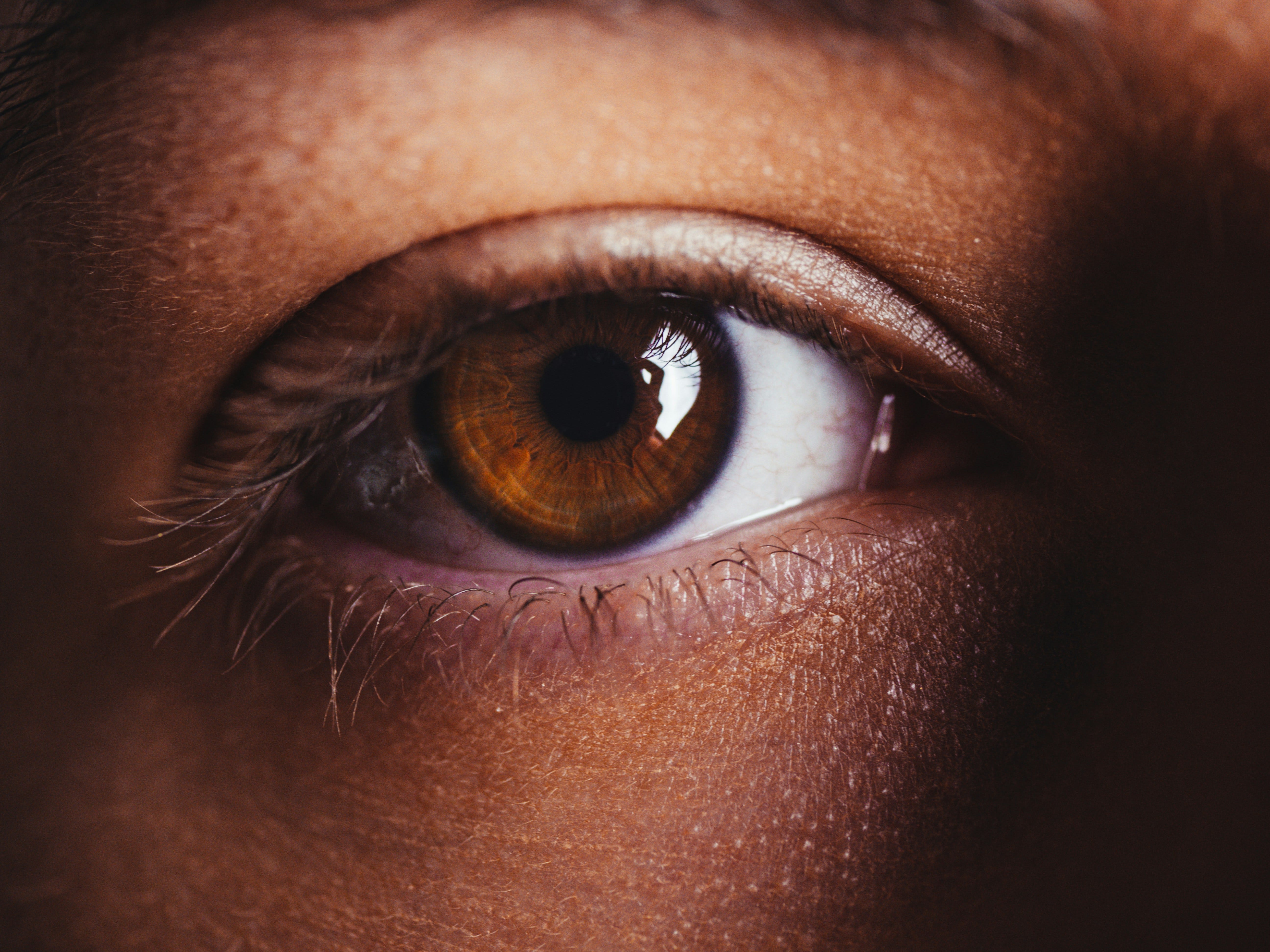
Part One of this story begins in a small cubicle in a bland office environment. Part Two (next week) ends with a discovery that the universe, at the subatomic level, has a lot more in common with human sexuality than we have ever imagined.
Along the way, I want to show you how the Core-Radiance pattern plays a critical role in how we see things and thus in our survival.
A disappointing search for objects
Long before Google existed, I worked for a technology company that did interesting things with automatic searches of video closed caption feeds. Great tech, great team, terrible product idea. The company went bankrupt six months after I joined them.
They were bought out by a company that did video surveillance. Weird tech, mediocre team, saleable product. There is a big demand for products that identify criminals, real or presumed, through the use of video technology.
Bank security managers would say “I want to be alerted when a known felon walks into the lobby.” They were serious, having seen such things often on television shows.
The company I was absorbed into had a huge business opportunity at the time.
The predominant technology for security videos was VHS tapes. Some individual would be paid to wear a uniform and sit in a windowless ‘Security Office’ to watch a bank of small video monitors and occasionally swap in new tapes. They had cabinets full of date-stamped video tapes.
The problem is this: storage is easy but retrieval is really, really hard!
If a case was to be investigated — let’s say an incident in the parking lot — this unseen, uniformed person would have to track down the right recorded footage. They would search for the right camera, on the right tape at the right time.
And for every tape swap there was the clicking and whirring of the machinery as it pulled the tape out of the cassette and wrapped it around the cylindrical head. A process that seemed to take longer as urgency and fatigue mounted.
The company I worked for offered a solution: networked digital video. In that business, the holy grail for the marketing team was automatic Object Detection!
Dominic, a graduate student doing a work term at our company, had based his thesis on Object Detection. He was in a strong career position — if his ideas worked. One day I passed by Dominic at his desk and I noticed a look of despair. ‘What was the matter?’ I inquired.
“It’s not working today. It worked yesterday. Why can it not see the box? It’s right there!”
He was staring at his computer screen, pointing to a video image of a dark blue box. The real box was twenty feet away, on a desk by the wall. The video image had a yellow rectangle painted around the box and also a good chunk of the wall behind it.
Non-technical people might assume that if you hook a video camera to a computer you can enable the computer to ‘see the world’.
But it’s not as simple as that. Not even close.
In the days before AI and LLMs did all the heavy lifting, software engineers had to figure things out for themselves. They had to invent clever ways to solve complicated problems. Computer ‘vision’ is a complicated problem. My colleague was getting annoyed that his solution was not working. His degree, his job, and possibly his career, were on the line.
Sandra, another young colleague, joined us. She looked at the video, looked at the box, and without intending to sound unkind, said “It’s too big. Look there’s the box. Why are you including all this?” She ran her finger across the computer screen where the image of the wall was.
“The ObjectDetector method is not doing so well today. It was working yesterday.” said Dominic.
I couldn’t help myself. I had to say something.
“There’s no such thing as objects.”
They looked up and stared at me in disbelief, as if I had said the Earth is flat. I explained:
“Dominic, your algorithm is not actually an ‘object detector’. It’s a dark pixel detector. It worked yesterday because the sun was shining on the wall behind the box, making those pixels lighter. Today, the wall is all dark pixels — so it got detected.”
Dominic did not look happy. Sandra made a defence of objects.
“Are you crazy? Of course there are objects! Look! The desk — an object! The monitor — an object! Everything you can see here is an object!”
I was surprised she left it at that and didn’t include the drawers in the desk — each of them objects. Or the cables trailing from the back of the monitor — more objects.
Of course what she was saying was common sense. And what I was trying to say was that common sense was lying to us. This was something I had learned in a previous life, when I had attended art school.
Learning to see
I had always considered my art school years to be a complete waste of time. But later in life, moments like this would suggest otherwise — art school had taught me how to see.
The last thing any of our professors would let us get away with was the use of common sense. They repeatedly reminded us to get rid of all preconceived ideas about, well, anything — especially what we see. They taught us to pay attention to what our eyes are actually telling us, not what we think we see!
Anyone with a camera will probably have used it to take a picture of something spectacular — a rainbow, a nice car, a colourful tree in the fall. And only later would they notice that a building or truck or passerby had blocked most of their subject. (It was worse when it took a week to get prints made at the drug store.) We thought we had gotten the shot but all we really got was noise.
Artists are trained to notice things — and to question things. In that way, they are like scientists. Paying attention to what hits the retina is the first step to representing visions about the world on a canvas.
When we do this — when we really look at things carefully — we can break things down. Familiar objects become new lines or shapes or perhaps just interesting textures. Certain details, previously unnoticed, suddenly stand out. Relationships between things are formed and then dismantled and then re-formed in new ways.
There is really no end to the ways you can learn to see things differently.
For sighted people, direct vision is our primary sense for determining what is real. Our eyes tell us the world is made of countless objects. But if we look at things beyond what our eyes can show us, we would see a different reality. This is where scientists are like artists: they invent new ways to see. Astrophysicists peer into the universe with high tech telescopes to see to the beginning of time. Physicists use particle accelerators and even mathematics to look into what makes up matter itself.
Our eyes are on the boundary between two extremes — the infinitely huge universe and the incomprehensibly small world of atomic events. They receive light from outer space and convert it into messages our brains can use to give us awareness. They are not simply cameras. They are intelligent organs, structured in ways that make our very existence possible.
The Core-Radiance pattern — nature’s secret for making our eyes smart
When you open your eyes, and light flows in, you might feel it jolt your senses — at least, before your first coffee. Most of the light that hits our retina came a long way to be here. And when it arrives it shows us the things we need to know about our environment — where the coffee pot is, the dog on the couch, a lover’s smile ...
When light hits the retina at the back of your eye, it is not the same as the light hitting the phone camera when you take a picture. The only thing that they have in common is that, at some point, the light becomes electrical energy.
The camera is a dumb instrument. It just records a matrix of light information. All the clever stuff — the tricks that make you look 20 years younger or magically swaps your background to put you in Paris — that all comes later with special software. Fundamentally the camera ‘retina’ is pretty passive. Picture a gigantic egg carton but it holds light, not eggs. Every light-holding photoreceptor is identical — there’s nothing special about any of them.
But the retina in a human eye is very special. It is far more intelligently structured and has significant built-in processing. For a start there are two kind of photoreceptors — called ‘rods’ and ‘cones’. For our purposes, it doesn’t matter what we call them. What is important is how they are positioned within the retina. The cones are compacted together in the centre, ready to take in colour and detail. The rods populate the outer area, the periphery, with fuzzier readings but highly sensitive to movement.
This makes sense. The motion sensitive area is the area you’re not looking directly at. If something is coming at you from the side — a car, a football linebacker, a tiger — you want to know about it as soon as possible. Then you turn to look at it and get as much detailed information as possible, so you can figure out what to do next.
Nature took advantage of a Core-Radiance pattern to do this. The retina has an intelligent Core-Radiant structure — a core area for focused, information-dense detail, and a radiant periphery to put everything into context.
There are about 120 million photoreceptors in a human retina. The information they gather collects into the optic nerve — a central ‘pipe’ which takes the data back to the brain. But to get there, that data has to be compressed to fit into the pipe. If all of those receptors went directly to the brain, the optic nerve would be as thick as a garden hose. Physiologically, that’s never going to work out.
So how does that data get compressed?
The retina makes smart decisions about the light information, responding to contrast rather than light levels, sharpening the edges and boundaries of things (boxes, walls, textures, etc).
And nature again uses a Core-Radiant strategy to do this. The cells are arranged with a ‘centre and surround’ pattern — a Tim Hortons donut with the Timbit left in the middle. Comparisons between the radiant outer receptors and those in the central core provide a mechanism to detect contrast.
And this happens not just once, but twice, in nested levels. The end result is a 100:1 compression rate. It’s not just less information — it’s high quality information about changes in the environment that is passed along to the brain. The brain can then focus on what those changes actually mean to the brain owner.
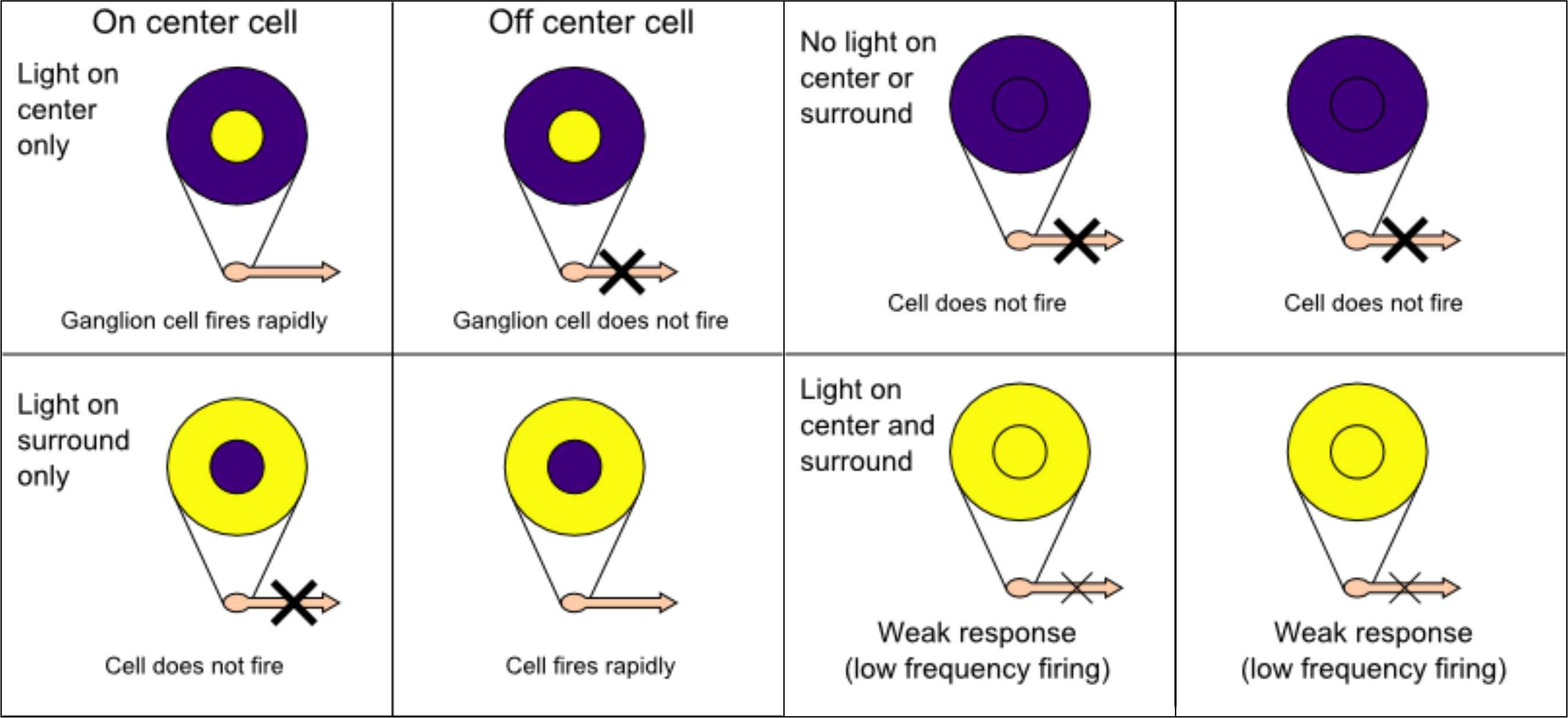
In all cases where we see the Core-Radiant pattern, the radiant information provides a context that allows the core centre to have more meaning.
By using a Core-Radiant pattern, nature has devised a remarkable strategy for optimizing what information gets sent from the eye to the brain. The brain is a busy organ and consumes 20% of the body’s energy. By reducing the extraneous data, this smart compression system makes good use of limited bandwidth in the optic nerve, saving physical space and precious metabolic energy.
To varying degrees, all creatures on the planet have this — insects, fish, frogs, mammals. Nature figured this out a long time ago. If we were to allow ourselves, for a moment, to see our biological inheritance as Nature’s technology, then we can marvel at the complexity and elegance of the human vision system. And that is just a small part of our story.
Dominic’s camera, and the one in your phone, were designed for profit. The eye’s built-in intelligence is structured for survival. A key part of this natural-technology miracle is the Core-Radiance Principle.
Through this series of articles I have shown examples of the Core-Radiance pattern in many contexts. And there are more. Next I will look deeper into the vision system to explore what is going on at the quantum level when light meets the eye.
References
Wikipedia:
Videos:
- On Center, Off Surround Ganglion Cells — Interactive Biology
- Center–Surround Receptive Field — garlandscience
- Visual Computations and Circuits / Receptive Fields — Bing Wen Brunton
- Center surround receptive fields — Mechanisms and Logic in Human Physiology
- Visual Processing and the Visual Cortex — Professor Dave